
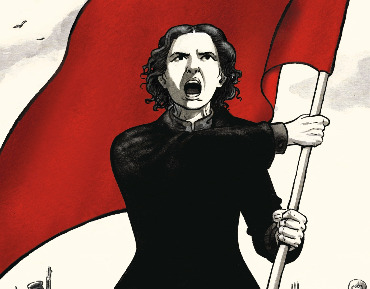
Rebel: How Louise Michel Stood with the Kanaks in Exile
When Louise Michel was sentenced to exile after the fall of the Paris Commune, the French state intended to remove her from the center of political life. In 1873 she was transported across the world to New Caledonia, a distant penal colony used to isolate political prisoners and suppress resistance. What the authorities did not expect was that exile would become another place where her convictions would be tested.
New Caledonia was not only a site of punishment. It was also a place where colonial injustice was starkly visible - and where Louise Michel’s loyalties would once again come into focus.
Exile as Revelation
In New Caledonia, Louise encountered the realities of colonial rule at close range. Indigenous Kanak communities had been dispossessed of their land, subjected to forced labor, and denied political and cultural autonomy. The language of “civilization” was used to justify domination, erasure, and violence.
For Michel, this was not unfamiliar. She recognized the same structures of power she had fought in France - systems that elevated a few while degrading the many. Exile sharpened her understanding that oppression was not confined to Europe, but was woven into the fabric of empire itself.
Learning and Teaching in Exile
Even as a deportee, Louise Michel remained committed to education. Teaching, for her, was never merely a profession - it was a way of engaging with the world, of exchanging knowledge, and of refusing to accept imposed hierarchies.
In New Caledonia, this commitment took on new meaning. She did not see herself as a civilizing agent, but as someone willing to listen, learn, and share. The cultures, languages, and knowledge of the Kanak people mattered to her, and she treated them with the respect she believed every community deserved.
Rebels Don’t Do Quiet, the story in this series set during her exile, is inspired by this period of her life. It draws from Louise Michel’s deep engagement with the people and the place around her, and from her refusal to detach herself from the moral questions raised by colonial rule.
A Rebel Beyond Borders
Louise Michel’s exile expanded the meaning of her rebellion. She was not only a French revolutionary opposing a French government; she was someone who recognized injustice wherever it appeared. Her political imagination was not limited by nationality, race, or geography.
Her writing from this period shows that she understood colonialism, capitalism, and hierarchy as interconnected systems. To oppose one while benefiting from another made no sense to her. Solidarity, if it meant anything, had to cross borders.
Why This Story Matters
I wanted to include Louise Michel’s time in New Caledonia because it reveals a side of her that is often overlooked. Exile did not erase her commitments - it clarified them. Removed from Europe, she continued to ask the same questions about power, dignity, and responsibility.
Rebels Don’t Do Quiet grows out of that spirit. It is not a tale of retreat or resignation, but of a woman carrying her principles into unfamiliar and difficult terrain.
Louise Michel’s life reminds us that rebellion is not only about where you stand, but about who you stand with. In exile, as in Paris, she refused to look away from injustice - and that refusal remains one of her most powerful legacies.